
Superabsorbent polymer made from agricultural waste
Nature's answer to drought, heat and water scarcity.
We develop naturally derived polymers that help farmers reduce irrigation and build resilience against drought.
ProductAre you a farmer or a distributor?
Benefits
What EF Polymer delivers
-
More crop resilience
Water held in the root zone extends the interval between irrigation or rainfall and cushions the impact of heat and drought.
-
Better soil health and structure
By swelling and contracting, it creates pores: more air in the root zone and more microbial activity.
-
Up to 40 % less irrigation and 20 % less fertiliser
Less water applied for the same soil moisture, and less nutrient leaching away from the root zone*.
-
100 % biodegradable
It returns to the soil in about 12 months, leaving no plastic residue.
*Results vary by crop, soil and conditions.
Ecosystem
A circular model that turns discarded agricultural waste into solutions for the field
EF Polymer is made by upcycling crop residues, such as fruit peel and pulp, that would otherwise be discarded. This 100 % naturally derived superabsorbent polymer helps farmers improve yield and reduce production costs, even in severe conditions such as drought.
What's more, harvest residues can be upcycled again to produce new EF Polymer, creating a sustainable cycle.
ProductTap each step to explore the EF Polymer ecosystem
01 Upcycling agricultural waste
EF Polymer is made by harnessing the power of nature. We upcycle agricultural waste such as orange peel, banana peel and other fruit residues, turning them into valuable resources.
02 Production of EF Polymer
After the residues are dried and milled, the pectin is extracted and blended. No petroleum-derived materials or chemical agents are used in the production of EF Polymer. Its defining feature is that the power of nature is harnessed at every stage.
03 Tackling water scarcity and the rising cost of fertiliser
EF Polymer helps farmers meet these challenges by holding water and nutrients in the soil for longer. This means significant water savings and less fertiliser use. By improving the soil's capacity to retain water and nutrients, EF Polymer also helps increase crop yield.
04 Sustainable farming: a circular model
Even in difficult environments, we help farmers achieve yield and improve soil quality, with long-term solutions to their problems. We also want to make a circular model of local production and consumption a reality, for example by upcycling local crops as raw material to produce the polymer.
News
Latest news
EF Polymer launches a field evaluation of processing tomatoes in California with The Morning Star Company and Kanematsu Corporation
Suntory Holdings and EF Polymer form a strategic partnership to tackle agricultural sustainability challenges
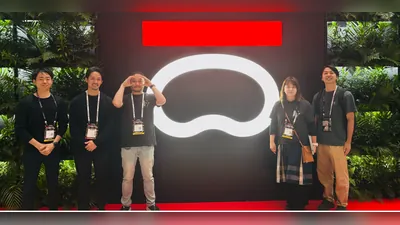
Corporate Partner Award at SusHi Tech 2026

EF Polymer will exhibit at in-cosmetics Korea 2026 (Seoul, 1–3 July)
EF Polymer and TLALOC BLUE partner to upcycle underused biomass
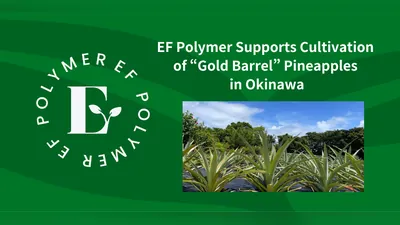
EF Polymer supports the cultivation of "Gold Barrel" pineapples in Motobu (Okinawa)
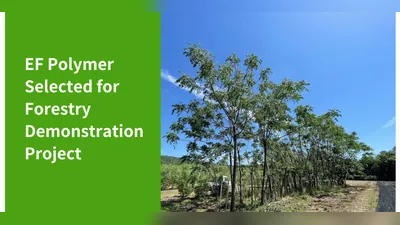
EF Polymer selected for a forestry demonstration project to stabilise seedling production
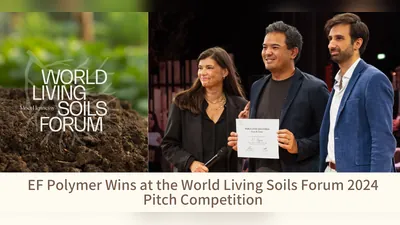
EF Polymer wins the World Living Soils Forum 2024 pitch competition
EF Polymer supports Ukrainian farmers in collaboration with around 50 companies in Okinawa
EF Polymer selected by Forbes Japan for "NEXT IMPACT STARTUPS 30"

Our origin
Supporting families and farmers affected by water scarcity
EF Polymer was born in Rajasthan, in north-west India: the driest state in the country, with more than 60 % of its area arid or semi-arid, less than 250 mm of rainfall a year in the west and between 600 and 700 mm around Udaipur, almost all of it in the three monsoon months. Farming there is family-run and rain-fed, on plots of one or two hectares that depend on that rain; when the monsoon fails, the family loses the year.
The idea came from one of those families: a farmer's son who was looking for a way to hold water at the root for longer and found the answer in the fruit waste of his region. The first trials and sales took place with his village neighbours in 2018; today the same product works with farmers in India, Japan, the United States and Europe.
About us
A superabsorbent polymer made from agricultural waste
- 100 % natural in origin
- Fully biodegradable